
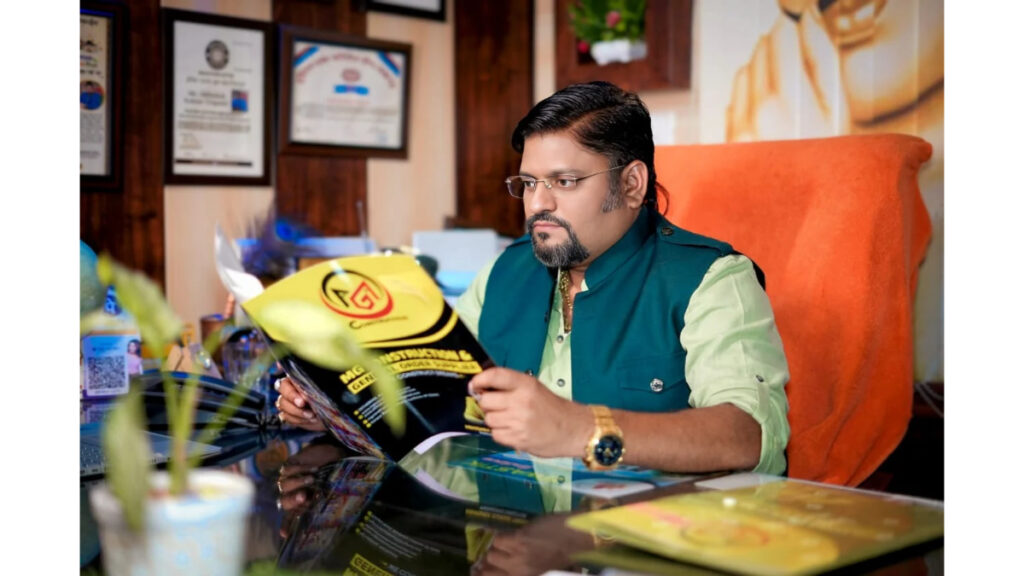
Lucknow (Uttar Pradesh) [India], October 23: Abhishek Kumar Tripathi is an Indian Air Force veteran, entrepreneur, social worker and the founder of MG Construction and General Order Supplier, based in Lucknow, Uttar Pradesh. Born on July 15, 1984, in Kannauj, he spent approximately two decades serving in the Indian Air Force before transitioning into entrepreneurship in 2022. His professional journey brings together military discipline, business development, housing solutions and a continuing interest in social welfare.
With academic qualifications in Arts, Law and Material Management, Tripathi has pursued a career that combines organisational management with practical business experience. Through MG Construction, he is involved in residential and commercial construction, architectural planning and interior design, with an emphasis on quality, transparency and dependable execution. His experience in the armed forces has also influenced his interest in housing for defence personnel and service-class families.
Beyond business, Tripathi has maintained an association with veteran welfare, charitable initiatives, spiritual service, animal welfare and environmental awareness. His activities have included supporting underprivileged communities, contributing to food distribution and community programmes, assisting Gurukuls and spiritual communities, and promoting compassion towards animals. He is also a family man, married to Pallavi Shukla, with two sons, Nilaksh and Vedant.
THE INSPIRING JOURNEY
The journey of Abhishek Kumar Tripathi reflects the evolution of a professional life shaped by military discipline, entrepreneurial ambition and a sustained interest in social welfare. After spending approximately two decades in the Indian Air Force, Tripathi moved into the business sector, establishing MG Construction and General Order Supplier in Lucknow in 2022. Since then, his work has centred on construction, housing, business development and community engagement, while his connection with the armed forces and veteran welfare has remained an important part of his identity.
As his professional and social responsibilities continue to develop, Tripathi’s journey offers an example of how experience gained in one field can influence decisions in another. His military background has informed his approach to management, while his understanding of the challenges faced by service personnel has influenced his interest in dependable housing. Alongside his business activities, he has maintained an association with charitable initiatives, spiritual service, animal welfare and community-oriented work.
An important part of this broader organisational picture is the role of new Secretary Madhu Singh, who is currently handling the responsibilities of the secretary. Her role in administrative coordination and organisational functioning adds another dimension to the work being carried out through the organisation. Together, leadership and administrative responsibilities are important to maintaining continuity, coordinating activities and ensuring that planned initiatives can be carried forward systematically.
A CAREER ROOTED IN DISCIPLINE AND RESPONSIBILITY
Born on July 15, 1984, in Kannauj, Uttar Pradesh, Abhishek Kumar Tripathi began his professional career in the Indian Air Force in 2001. His approximately twenty years of service became a formative period, exposing him to a working environment in which discipline, teamwork, punctuality and accountability were essential to daily responsibilities.
Military life also provided him with direct exposure to the realities faced by service personnel and their families. Frequent postings and transfers can make it difficult to establish long-term stability, particularly when families are trying to secure permanent housing. These experiences later became relevant to Tripathi’s decision to establish a construction business after completing his military career.
His educational background includes a Bachelor of Arts, a Bachelor of Laws and an MBA in Material Management. These qualifications, combined with his military experience, gave him a foundation in organisational management, legal understanding and resource planning. They also provided useful preparation for the practical demands of entrepreneurship, where decisions involving people, materials, budgets and timelines often determine whether a business can meet its commitments.
Rather than treating his departure from the Air Force as a complete break from his earlier professional life, Tripathi carried forward many of the principles developed during his service. His subsequent career has continued to reflect the importance of planning, taking responsibility for decisions and maintaining a disciplined approach to work.
MG CONSTRUCTION AND THE IDEA OF BUILDING WITH PURPOSE
In 2022, Tripathi established MG Construction and General Order Supplier in Lucknow, beginning a new chapter in his professional journey. The business operates in the construction sector, with services associated with residential and commercial projects, architectural planning and interior design.
Construction is an industry in which a company’s responsibilities extend beyond the completion of a physical structure. For many clients, building a house represents years of savings, careful financial planning and the aspiration to provide security for their families. A commercial project can similarly represent a major investment in someone’s livelihood or future growth. Understanding these commitments has influenced Tripathi’s emphasis on quality, transparency and dependable project execution.
His interest in housing also has a personal foundation. Having experienced the demands of military life, he understands why a stable home can be particularly important to defence personnel and service-class families. This perspective has informed his interest in practical and budget-conscious housing solutions, with the aim of making the construction process more reliable for clients.
For Tripathi, the objective is not simply to construct buildings but to develop a business based on trust. Clear communication, organised execution and attention to client requirements are essential elements of this approach. In an industry where delays and misunderstandings can create substantial difficulties, he sees accountability as an important part of maintaining a professional reputation.
His longer-term challenge will be to expand the business while retaining these standards as projects, teams and operational requirements grow. Sustained performance in construction depends not only on ambition but also on the ability to manage resources, coordinate workers and maintain consistency from one project to the next.
WHEN MILITARY EXPERIENCE MEETS THE NEED FOR A HOME
The relationship between Tripathi’s military past and his work in construction became particularly evident when an MG Construction-built home was handed over to a fellow Air Force officer who had completed two decades of service.
The occasion carried a personal connection for Tripathi, who had himself spent approximately twenty years in the Air Force before moving into entrepreneurship. The experience of serving in the same institution gave him an understanding of the professional journey that the recipient had completed, while his construction business provided a way to contribute to an important milestone in that officer’s life.
The home handover illustrated how the lessons and experiences of one career can influence the direction of another. What Tripathi had witnessed during his years in service became part of the perspective he brought to his business, particularly in relation to housing and family stability.
For service personnel, a home can provide a lasting connection to a place after years of professional movement. For a construction entrepreneur, delivering that home requires technical planning, financial management and consistent execution. The meeting of these two perspectives represents an important part of Tripathi’s professional story.
It also demonstrates the potential for businesses to address needs that their founders understand through personal experience. In Tripathi’s case, the connection between military service and construction is not merely biographical; it informs the purpose he associates with his work.
A BROADER ENTREPRENEURIAL OUTLOOK
Although MG Construction remains a central part of Tripathi’s professional identity, his business interests extend towards a broader vision of entrepreneurship. He has explored the development of additional ventures intended to serve practical consumer needs and create opportunities for employment.
MG Pansari forms part of this wider vision, with a proposed focus on everyday household essentials and consumer products. The concept reflects an interest in businesses that are connected with routine needs and can potentially build relationships among consumers, suppliers, local producers and workers.
Such expansion requires more than identifying a market opportunity. It involves developing reliable supply chains, managing costs, maintaining product quality and building consumer confidence. Tripathi’s background in material management is relevant to these challenges, particularly where procurement and resource planning play a major role.
His approach to business development is rooted in the idea that an enterprise should be capable of creating value for more than its owner. Employment opportunities, supplier relationships and the development of organised operations can all contribute to a business’s wider economic role.
The next phase of this vision will depend on how effectively these plans are implemented and how consistently each venture can meet the expectations of its customers. For Tripathi, the aim is to develop businesses with a clear operational foundation rather than pursue expansion without adequate planning.
NEW SECRETARY MADHU SINGH AND THE IMPORTANCE OF ORGANISATIONAL COORDINATION
As Tripathi’s work involves business leadership as well as activities connected with community and veteran welfare, organisational coordination remains an important requirement. Madhu Singh, the new Secretary, is currently handling the responsibilities of the secretary, contributing to administrative coordination and the functioning of the organisation.
The secretary’s responsibilities are important to the practical management of organisational activities. Planning programmes, coordinating communication, maintaining continuity and ensuring that assigned responsibilities are followed through all require consistent administrative attention. The effectiveness of such work often depends on clear communication between leadership and the people responsible for implementing decisions.
Madhu Singh’s role should therefore be understood within the wider framework of organisational functioning. As secretary, she is handling the responsibilities associated with the position while contributing to the coordination needed for activities to proceed in an orderly manner.
The inclusion of a designated secretary also highlights the importance of distributing responsibilities within an organisation. Leadership may establish priorities and define objectives, but administrative coordination helps translate those objectives into practical activity. Clear responsibilities can support continuity and make it easier to manage programmes, communication and day-to-day requirements.
For Tripathi, whose professional journey has involved managing different responsibilities across business and social initiatives, effective coordination is an important part of sustaining organised work. The role being undertaken by Madhu Singh forms part of this administrative structure.
CONTINUING THE CONNECTION WITH VETERAN WELFARE
Tripathi’s relationship with the armed forces has continued after his departure from active service. His experience as an Air Force veteran has encouraged him to remain connected with former servicemen and their families, particularly through activities concerning veteran welfare and community support.
Transitioning to civilian life can bring new practical considerations for former service personnel, including employment, healthcare, financial planning and access to relevant government schemes. Support networks and reliable information can help veterans navigate these concerns, making coordination among organisations and community representatives important.
Tripathi’s involvement in veteran-related activities reflects his continued connection with the community that shaped his early professional life. His own experience provides context for his interest in issues affecting ex-servicemen, although each veteran’s circumstances and requirements may differ.
The broader objective of veteran welfare is to ensure that service to the country remains recognised while former personnel and their families are able to access appropriate support and opportunities. Maintaining communication, sharing information and facilitating connections are practical ways in which organisations can contribute to that objective.
For Tripathi, this involvement represents continuity rather than a return to his former profession. He has built a new career in business while retaining an interest in the welfare of the people with whom he shares a military background.
SOCIAL SERVICE, SPIRITUALITY AND COMMUNITY ENGAGEMENT
Alongside his commercial responsibilities, Tripathi has participated in activities involving food distribution, community meals, Kanya Vivah initiatives, support for underprivileged families and assistance to Gurukuls and spiritual communities. These activities reflect an interest in providing practical help to people who may have limited resources or require support during important stages of life.
His approach to social service is closely connected with his spiritual beliefs. Participation in religious occasions, assistance to saints and contributions towards community welfare have formed part of his personal activities. For him, faith and service are closely related, with charitable work providing a practical expression of values associated with compassion, gratitude and responsibility.
Support for Gurukuls, including the provision of useful items for students, reflects the importance he places on helping educational and spiritual communities. Assistance with food and ration requirements for saints and people in need similarly demonstrates how small, practical contributions can address everyday requirements.
His charitable involvement has also included using personal celebrations as opportunities to share with others. Birthdays and family occasions have been associated with feeding people, spending time with children and supporting charitable activities. Such gestures reflect a preference for connecting personal milestones with community participation.
Social service requires consistency if it is to create lasting benefits. While individual initiatives can meet immediate needs, sustained efforts often depend on coordination, available resources and continued engagement with the people being served. This is another area in which organised planning and clear responsibilities can contribute to effective work.
ANIMAL WELFARE AND ENVIRONMENTAL RESPONSIBILITY
Tripathi’s interest in social responsibility also extends to animals and the environment. He has a strong affection for animals, particularly his dogs, Sartaj and Khalifa, and has been involved in efforts to feed and assist stray animals. His interest in animal welfare and Gau Seva reflects a broader understanding of compassion that extends beyond human communities.
Animal welfare can involve a range of practical activities, from providing food and supporting medical treatment to encouraging responsible care and awareness. These efforts depend on regular attention and cooperation, particularly when addressing the needs of stray animals that may not have consistent access to shelter or veterinary assistance.
Environmental awareness is another aspect of Tripathi’s wider outlook. Tree plantation and interest in nature conservation complement his professional involvement in construction, a sector where planning and development decisions can have long-term environmental consequences.
Responsible development requires consideration of how projects affect their surroundings, how resources are used and how environmental concerns can be incorporated into planning. While commercial growth remains important to a construction business, environmental awareness can help encourage more thoughtful decisions about the built environment.
These interests provide a broader picture of Tripathi’s personal priorities, showing that his activities are not limited to business and veteran welfare but also include causes connected with compassion and the environment.
FAMILY, VALUES AND THE PERSONAL SIDE OF LEADERSHIP
Despite his professional and social commitments, family remains an important part of Tripathi’s life. He is married to Pallavi Shukla, who has worked as a music teacher with the Mahila Kalyan Vibhag since 2008. The couple have two sons, Nilaksh and Vedant, and the family is based in Lucknow.
His personal life provides context for the values he brings to his professional work. The importance he places on family stability is consistent with his interest in housing, while his involvement in charitable activities reflects the role of spirituality and community in his outlook.
Leadership also involves balancing competing responsibilities. Business operations require attention to planning and execution, while social activities demand time, coordination and engagement with people. Maintaining that balance requires prioritisation and a clear understanding of where personal involvement is most useful.
Tripathi’s journey illustrates how professional ambitions and personal values can develop alongside each other. His identity as an entrepreneur does not exclude his connection with the military community, and his business responsibilities exist alongside his interest in philanthropy and spiritual service.
A DEVELOPING CHAPTER IN BUSINESS AND SOCIAL RESPONSIBILITY
Abhishek Kumar Tripathi’s professional journey has moved through distinct stages, from military service to entrepreneurship and from construction to a wider set of business and community interests. Each stage has added a new responsibility while retaining elements of the discipline and sense of duty established during his years in the Indian Air Force.
MG Construction represents his principal entrepreneurial venture, while his wider business plans point towards opportunities in additional sectors. His continued association with veteran welfare preserves a connection with his earlier career, and his charitable activities reflect personal values that extend beyond commercial objectives.
The role of new Secretary Madhu Singh adds an organisational dimension to this broader picture. Her handling of the secretary’s responsibilities supports the administrative and coordination work necessary for organised activities, highlighting the importance of defined roles as responsibilities develop.
The long-term significance of Tripathi’s journey will depend on how successfully his businesses grow, how consistently they meet their commitments and how effectively his social initiatives respond to the needs of the communities they seek to support. These are continuing efforts rather than completed achievements, requiring sustained attention and practical results.
His story ultimately centres on the relationship between experience and purpose. Two decades in the Air Force provided the foundation for his understanding of discipline and responsibility; entrepreneurship offered a new platform through which to apply those principles; and community engagement has allowed him to maintain an active connection with causes beyond business.
As he continues to develop his professional interests and social commitments, the central challenge will be to preserve that connection between ambition and responsibility. His journey from uniformed service to business leadership demonstrates how a career can change direction while retaining the values that first shaped it.
If you object to the content of this press release, please notify us at [email protected]. We will respond and rectify the situation within 24 hours.